Item tracking for reliable process automation
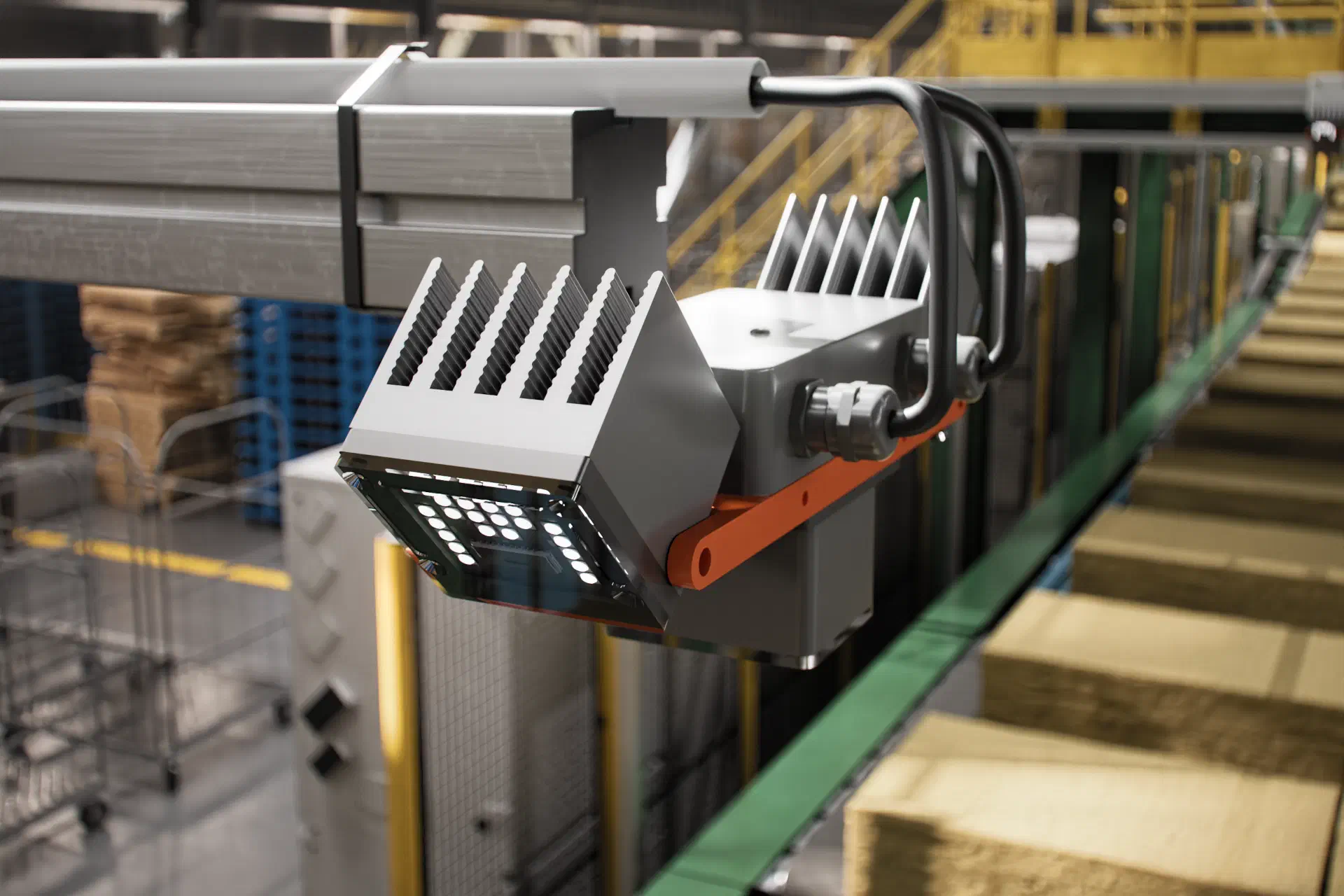
A system to improve the reliability of existing line automation by providing accurate visual tracking of items on a large conveyor. The system prevents the occurrence of automation faults caused by the previous trigger sensor tracking scheme when faced with unexpected or challenging item position, size or motion.
Problem
A customer was struggling with recurring faults due to errors in item tracking on their production line. These led to disruptive automation failures and caused both an increased manning costs and an inability to fully utilise the capabilities of their automation systems.
The line produced items in batches that moved along the line with a gap between each batch. For a given production run, each batch would contain 1-6 items of sizes up to 3m in the longest axis. The line control system tracked items along the conveyor for several metres using laser sensors and conveyor drive speed to an automated rejection point which removed any batches containing defects.
Operators on site regularly reported the automation system failing to reject the correct items. Sometimes the port would reject the wrong batch, sometimes no batch would be rejected and defective products would continue along the conveyor unless an operator noticed in time. As a result, automation was regularly being disabled and replaced by expensive manual operators.
Analysis of the fault cases showed the existing tracking system becoming confused when items did not progress at exactly the speed expected. A significant cause was unpredictable acceleration lag as objects transitioned between conveyor sections. This also led to batches moving out of alignment - so a trigger sensor pointing through one lane of production could not be relied upon to provide accurate timing signals for the rest of the batch.
The system was also easily confused by items which were not of the expected dimensions and by manual removal of items from the line for spot checks.
The areas in question were accessible to human operators. Any system needed to be eye safe and tolerant to the presence and potential interference of personnel and also resilient to ambient lighting changes. Conveyor surfaces ranged from shiny metal rollers to matt black belts. No changes could be made to the conveyor to make the appearance more consistent or easier to process.
Solution
The OCAS Track system was developed for such applications based on a single camera head, high power near-infrared light emitters and a compact processing unit which can be easily mounted over the conveyor. Track units can be daisy-chained to cover arbitrary conveyor lengths and use a software bus to synchronise lighting and propagate tracking data.
Track divides the view of the moving conveyor into a series of lanes to match current production and uses statistical analysis to determine adaptive thresholds which vary with time and position. As product appearance and background lighting vary this continuous adaptation maintains robust segmentation of items from the background conveyor.
If items are removed, the system uses the last known velocity for the conveyor at each point so that a notional result can be delivered at an appropriate time to inform the line automation system that an expected item is now missing.
The image processing required to perform tracking is lightweight by design and allows responsive performance from modest processing hardware.
Since deployment manning has been removed from the rejection point completely and the automated systems now reliably run at full capacity. Further waste savings have been achieved as additional physical production optimisations can now be consistently delivered by the line without risking failures at the rejection point due to tracking issues.
Track has demonstrated extreme robustness to the presence of noise, personnel and variation in lighting conditions and delivered an unprecedented level of tracking reliability. As a result an existing automation system that was viewed as troublesome has been transformed into a vital, fully functional part of the production line.